

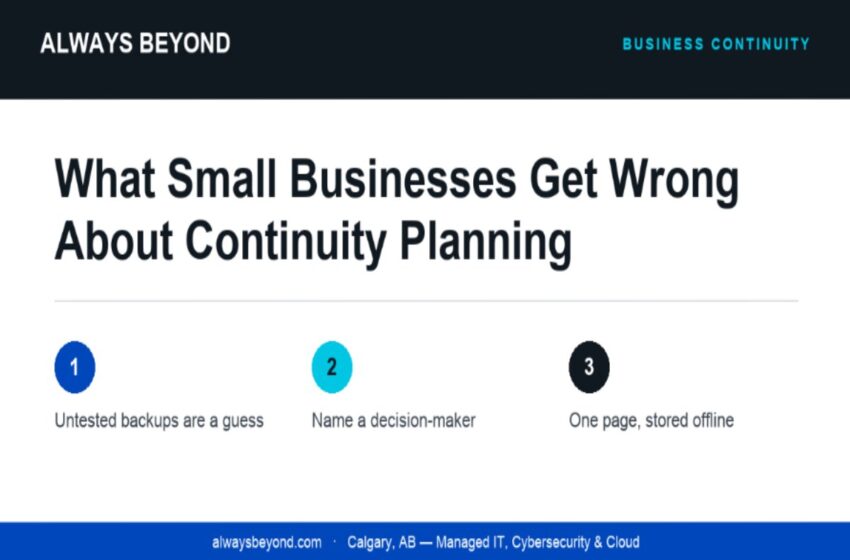
What Small Businesses Get Wrong About Business Continuity Planning
Ask a small business owner what happens if the server dies tomorrow, and watch the pause before the answer. That pause is the whole article. It’s the gap between “we have backups” and “we have a plan,” and most businesses live comfortably inside that gap right up until the day it costs them.
Business continuity planning sounds like the kind of phrase that belongs in a binder nobody opens, which is exactly the problem. Strip away the jargon and it just means having a clear answer to “what do we do when something breaks.” A server failure, a flooded office, a ransomware attack, the event changes, but the questions underneath it never do: how do we keep working, and who’s actually deciding. Most small businesses aren’t short on tools. They’re short on an answer.
The Three Gaps, and Why They’re So Comfortable to Ignore
Backups exist almost everywhere. Tested backups are rarer than people assume. A backup nobody has ever restored isn’t a safety net, it’s a guess wearing a safety net’s clothing, and plenty of businesses discover theirs was incomplete or years stale only once they need it, which is the single worst moment to find out.
Then there’s the recovery plan that exists only in someone’s head. People genuinely believe they know what they’d do. That holds up fine until the person carrying it is unreachable, or three systems fail at once and four people need the same information and nobody wrote it down anywhere.
And underneath both sits the quietest gap: nobody has actually named who’s in charge if the owner isn’t around. A lot of small businesses run on one or two people making every real call. If that person is on a flight or unreachable when the incident starts, decisions stall exactly when speed matters most. None of these three gaps is dramatic alone. Stacked together, an untested backup, an unwritten plan, an unclear chain of command, they turn one bad afternoon into a multi-day scramble that didn’t need to happen.
Progress Doesn’t Require a Binder
You don’t need consultants and a policy document nobody will read. Start smaller. Write down the systems the business genuinely cannot operate without: email, the core software, phones, payment processing. Pick the most important one and test its backup this month, even onto a spare machine, and note honestly what worked. Name a decision-maker and a backup person, someone with authority to spend money or call in outside help if the owner can’t be reached. Put a one-page plan together: who to call first, where backups live, the first steps for the scenarios most likely to hit this business. Store it somewhere that isn’t the server that just went down, because a plan trapped on dead hardware isn’t a plan.
Each takes an afternoon, not a quarter. What matters is doing them, not how polished the document looks afterward.
| No continuity plan | Basic continuity plan |
| Backup exists but was never restored | Backup tested at least once, on a schedule |
| Recovery steps live only in memory | Recovery steps written, one page, offline |
| Unclear who decides during a crisis | Named decision-maker and a backup person |
| First hours spent figuring out who to call | Contact list ready before anything breaks |
| Recovery measured in days of confusion | Recovery measured in hours of following a plan |
The Drama Isn’t the Point
It’s tempting to picture continuity planning as being about the big, cinematic disasters, fires, floods, ransomware headlines. In practice, most disruptions are quieter: a failed drive, a botched update, someone clicking a link they shouldn’t have. The plan doesn’t need to anticipate every catastrophe Hollywood could dream up. It needs a real answer for the three or four things most likely to happen here, and the people involved need to know where that answer lives.
I’d guess most owners reading this already suspect their plan wouldn’t survive a real incident. That instinct is usually correct, and it’s the easiest problem here to fix, which is why the Always Beyond team builds this kind of planning into its work with Calgary clients rather than filing it away.
Pick one system this week and test its backup. That single step will tell you more about your actual exposure than any policy document has ever told anyone, sitting quietly in a drawer, unread.